A Complete Technical Guide to Design, Usage, and Compatibility
Hotkey switching is one of the most efficient control mechanisms on TESmart KVM switches. For users managing multiple computers, displays, and peripherals, hotkeys enable fast, uninterrupted switching without leaving the keyboard.
Because hotkey behavior is closely tied to hardware design and model generation, this article explains how TESmart hotkeys are designed, how they differ across product generations, and how users can rely on them in real-world workflows.
1. Why TESmart KVM Switches Use Hotkey Switching
TESmart KVM switches support multiple switching methods, including:
-
Keyboard hotkeys
-
Front-panel buttons
-
Mouse-based switching (middle mouse button, supported models)
Hotkey switching is designed for users who prioritize:
-
Speed and efficiency
-
Hands-on-keyboard workflows
-
OS-independent control, including BIOS and login screens
For developers, engineers, traders, and professional workstation users, hotkeys often provide the most consistent and fastest switching experience.
2. Core Design Logic of the TESmart Hotkey System
To understand how hotkeys work, it is essential to understand where they are processed.
2.1 Dedicated Keyboard and Mouse Ports
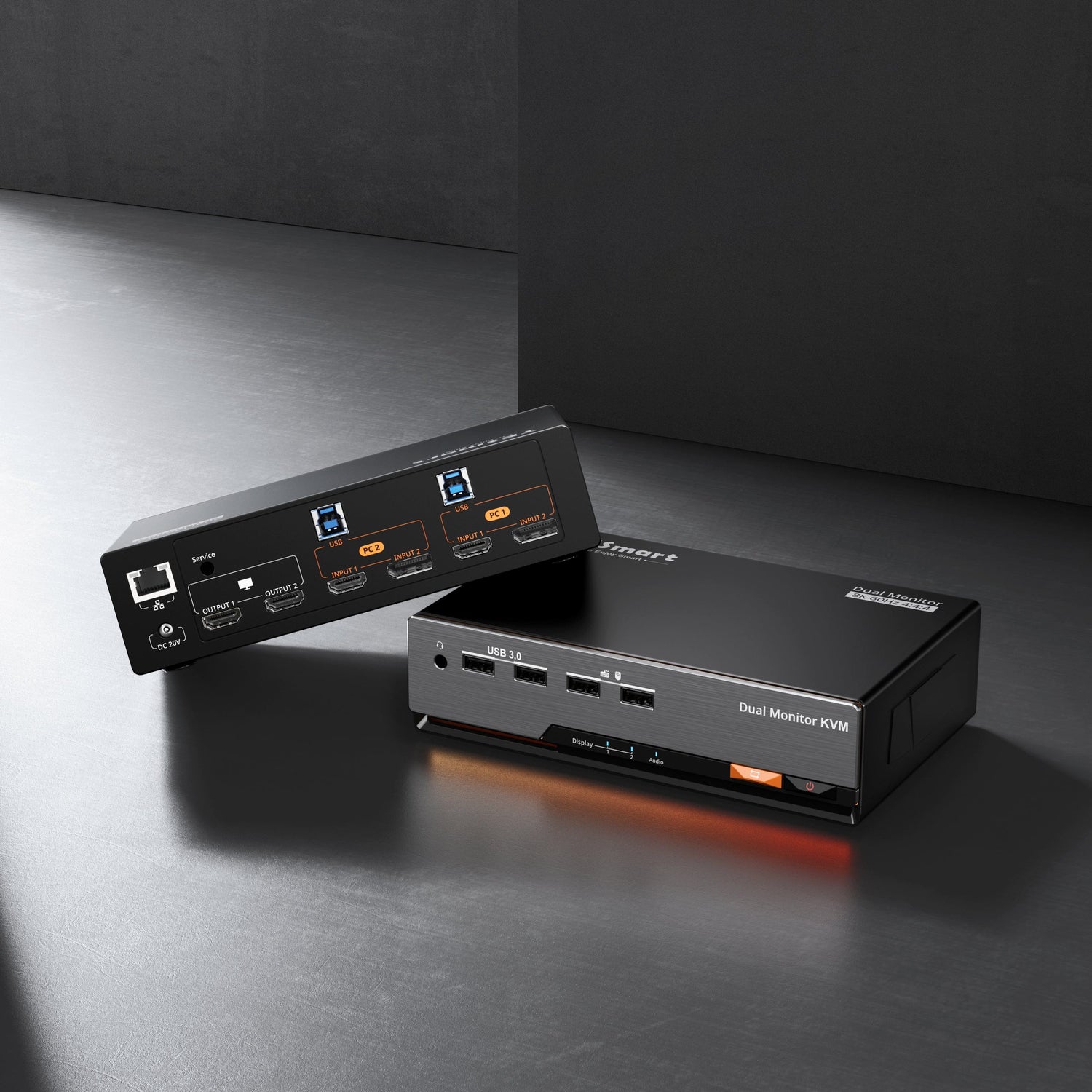
TESmart KVM switches include dedicated keyboard and mouse ports, separate from standard USB ports.
-
Hotkey commands must be detected before signals are forwarded to the connected computer.
-
Dedicated ports allow the KVM controller to intercept and interpret keyboard input in real time.
-
Standard USB ports operate in passthrough mode and do not participate in hotkey detection.
Key technical principle:
Hotkey detection occurs at the KVM controller level, not at the USB hub level.
For reliable hotkey functionality, keyboards must always be connected to the dedicated keyboard port.
2.2 Why TESmart Uses a “Double Trigger + Command Key” Structure
TESmart hotkeys use a two-stage sequence:
-
Press the trigger key twice
-
Press a command key within a short time window
This design:
-
Prevents accidental activation during normal typing
-
Avoids conflicts with OS-level shortcuts
-
Works consistently across Windows, macOS, Linux, BIOS, and UEFI
This structure prioritizes predictability and cross-platform reliability over minimal keystrokes.
3. Trigger Key System Explained
3.1 Evolution of the Default Trigger Key
Early TESmart KVM models used Scroll Lock as the default trigger key due to its low usage in modern operating systems and stable HID behavior.
Later generations transitioned to Right Ctrl as the default trigger key because:
-
It aligns better with common keyboard usage habits
-
It is rarely used in standard OS shortcuts
-
It improves ergonomics for frequent switching
This change reflects TESmart’s evolution from traditional IT use cases toward modern productivity workflows.
3.2 Trigger Key Configuration Across Generations
Trigger key behavior differs by product generation:
-
Early models allow switching between:
-
Scroll Lock
-
Left Ctrl
-
Right Ctrl
-
-
Newer models support custom trigger key configuration, allowing users to define a trigger key that best fits their keyboard layout and usage habits.
Trigger key configuration is a hardware-level feature and is model-dependent.
Always refer to the official support documentation for your specific model.
4. Hotkey Function Categories
TESmart hotkeys fall into several functional categories. Not all functions are supported on all models.
4.1 Input Switching Hotkeys
These hotkeys control switching between connected computers:
-
Direct switching to a specific input (PC1 / PC2 / PC3 / PC4)
-
Sequential switching through available inputs
-
Forward or backward cycling
Input switching hotkeys are the most reliable and fastest switching method, as they do not depend on video synchronization state.
4.2 System-Level Control Hotkeys (Model Dependent)
Depending on the KVM model, hotkeys may control system-level features such as:
-
Buzzer on/off
-
Auto-scan mode
-
USB network interface enable/disable
-
EDID emulation enable/disable
-
USB switching behavior
Because these functions are implemented at the hardware controller level, availability varies by model and generation.
5. Keyboard and Mouse Handling Modes
TESmart KVM switches support different keyboard and mouse handling modes depending on the model.
5.1 Passthrough Mode (Direct Mode)
In passthrough mode:
-
The keyboard and mouse behave as if directly connected to the active computer
-
Device-specific drivers and advanced features are preserved
-
Some programmable or wireless keyboards may interfere with hotkey detection
This mode prioritizes device fidelity over abstraction.
5.2 Compatibility Mode (Traditional Mode)
Compatibility mode is designed to maximize stability across:
-
Older operating systems
-
Legacy hardware
-
Non-standard HID implementations
This mode provides more predictable behavior in complex or mixed environments and may improve hotkey reliability when using unconventional input devices.
6. Why Hotkeys Sometimes Do Not Work
In most cases, hotkey issues are caused by configuration or device behavior rather than hardware defects.
Common causes include:
-
Keyboard connected to a standard USB port instead of the dedicated keyboard port
-
Use of wireless, Bluetooth, or macro-enabled keyboards
-
Keyboard software intercepting or remapping keys
-
Incorrect trigger key configuration
-
Hotkey function not supported by the specific model
Understanding these conditions helps reduce unnecessary troubleshooting and support requests.
7. Choosing the Right Switching Method
TESmart provides multiple switching methods to accommodate different workflows.
| Switching Method | Strengths | Best For |
|---|---|---|
| Hotkeys | Fast, keyboard-centric | Power users |
| Front-panel buttons | Simple and visual | General users |
| Mouse-based switching | Hands-on-mouse workflows | Multi-tasking environments |
Users may choose one or combine multiple methods based on personal preference.
8. Official Hotkey Reference and Support Resources
To make hotkey functionality easier to access and avoid reliance on printed manuals, TESmart provides a centralized support reference:
Full TESmart Hotkey Reference (All Models)
TESmart KVM Switch Hotkeys: Feature Overview by Model – TESmart
This resource lists all supported hotkey functions by model and generation and is continuously updated as new products are released.
9. Final Thoughts
TESmart’s hotkey system is designed to be:
-
Consistent across operating systems
-
Predictable across hardware generations
-
Efficient for real-world professional workflows
By understanding how hotkeys are implemented and how they vary by model, users can fully leverage TESmart KVM switches with confidence and clarity.