

Table of Contents
- Introduction
- Why the 2026 Game Season Changes the Setup
- Why an HDMI Splitter or HDMI Switch Is Not Enough
- What an HDMI Matrix Solves in a Bar or Pub
- Who Actually Needs This?
- How to Plan a Bar Sports Streaming Setup Before Game Season
- Why TESmart HDMI Matrix Fits Sports Bar AV Routing
- Common Mistakes to Avoid
- FAQ
- Conclusion
Introduction
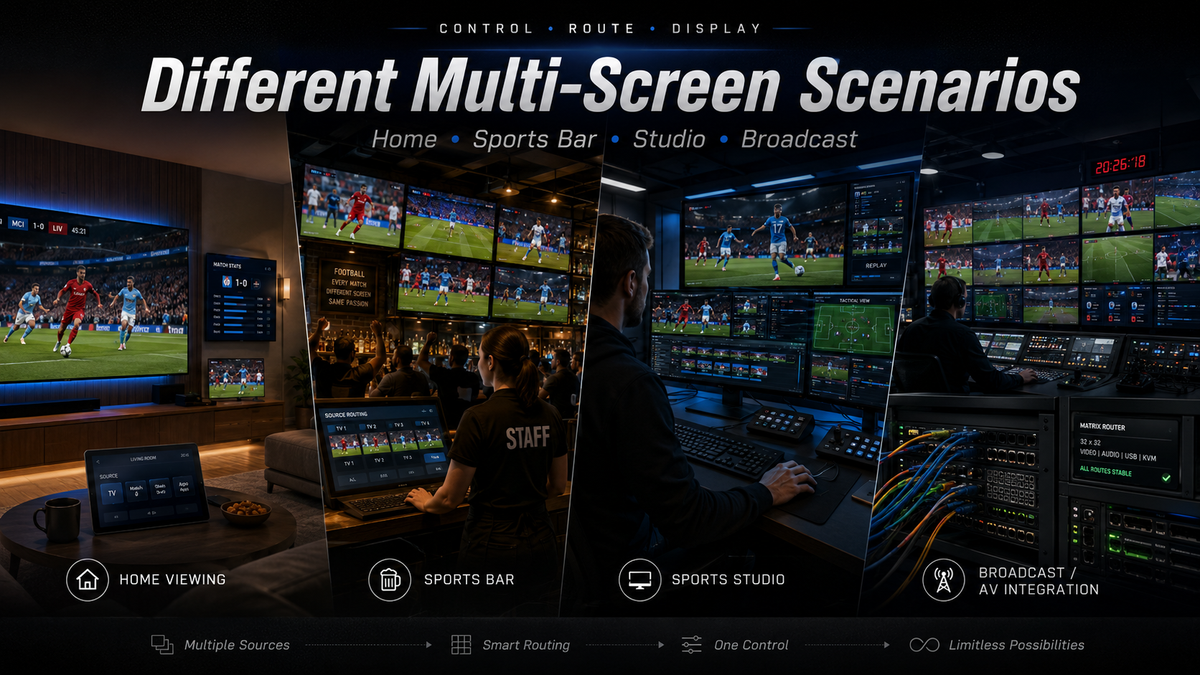
A busy sports bar does not fail because one TV cannot show a game. It usually fails because several TVs need to show different games, from different sources, in different areas, while staff are already managing orders, sound, reservations, and customer requests.
That is why a serious Bar sports streaming setup or Pub sports streaming setup needs more than a basic HDMI accessory. During the 2026 game season, many bars, pubs, restaurants, and entertainment venues will need to handle football matches, international tournaments, league games, live commentary, highlight feeds, and advertising screens at the same time.
The real question is not simply, “How do I connect one source to one TV?” The more practical question is: “How do I send the right source to the right screen without constantly touching cables?”
That is where an HDMI matrix for multiple TVs becomes important. A splitter copies one source. A switch selects one source for one display. An HDMI matrix switch allows multiple HDMI sources to be routed independently to multiple displays.

Why the 2026 Game Season Changes the Setup
The 2026 game season will put more pressure on public viewing spaces because customer expectations have changed. In many venues, guests no longer expect every TV to show the same broadcast. They may want one screen showing a football match, another showing a second live game, a third showing a pre-game panel, and another showing scores or venue promotions.
For a small home setup, one streaming box and one TV may be enough. For a bar or pub, the display system becomes part of the customer experience. Poor routing creates practical problems:
Staff need to unplug and reconnect HDMI cables behind TVs or cabinets.
One source accidentally replaces the wrong screen.
A key match is interrupted while another display is being changed.
Customers in different seating zones cannot watch the game they came for.
The venue depends on one person who understands the wiring.
A football match multi-screen setup needs predictable routing. When the match schedule is busy, the AV system should let staff assign sources to screens quickly instead of rebuilding the cable layout during service.

Why an HDMI Splitter or HDMI Switch Is Not Enough
HDMI splitters and HDMI switches are useful, but they solve simpler problems. Many bar owners buy one of them first because the names sound close to “matrix.” In practice, the routing logic is different.
| What a splitter does | What a switch does | What an HDMI matrix solves |
|---|---|---|
| Copies one HDMI source to multiple displays. | Selects one source from multiple inputs for one display. | Routes multiple HDMI sources independently to multiple displays. |
| Useful when every TV should show the same game. | Useful when one TV needs to switch between a set-top box, PC, or console. | Useful when different TVs need different games, channels, or media sources. |
| Does not let each TV choose a different source. | Usually controls one output, not a full multi-TV venue. | Allows flexible source-to-screen assignment across zones. |
| Good for simple duplication. | Good for single-screen input selection. | Better for sports bars, pubs, restaurants, and event spaces with multiple TVs. |
If your venue only needs one game mirrored to every screen, a splitter may be enough. If one TV needs to choose between a cable box and a laptop, a switch may be enough. But once you have multiple TVs multiple sources, the system becomes a routing problem, not just a connection problem.
That is the main reason a sports bar HDMI matrix is different from a basic HDMI splitter. It gives each display an assigned source instead of forcing every display to follow the same input.
What an HDMI Matrix Solves in a Bar or Pub
An HDMI matrix sits between your sources and your displays. Sources may include set-top boxes, streaming devices, PCs, media players, game consoles, or AV receivers. Displays may include wall-mounted TVs, bar counter screens, private room TVs, projector displays, or advertising monitors.
Instead of wiring each source directly to one TV, the matrix becomes the central routing point. This makes a multi-screen sports viewing setup easier to operate.
Different Games on Different Screens
During tournament periods, several matches may overlap. A bar may want the main screen to show the highest-demand football match, side screens to show other games, and smaller screens to show live stats or commentary.
With an HDMI matrix switch, one source can be sent to one display, several displays, or all displays depending on the viewing plan. This gives the venue more control over seating zones and customer groups.
One Source to Many Screens When Needed
A matrix does not replace the duplication function of a splitter; it expands it. If a major match starts, the venue can route the same source to every TV. When the match ends, screens can return to different sources without changing cables.
This is useful for bars that shift between “all screens on the main event” and “different screens for different games” throughout the day.
Less Manual Cable Handling
Manual HDMI changes are not just inconvenient. They increase the chance of loose connections, damaged ports, mislabeled cables, and staff mistakes. In a commercial environment, the best cable is often the one nobody needs to touch during service.
A central HDMI matrix reduces physical cable handling. Staff can manage source routing from the matrix interface or supported control methods, depending on the model and system design.
More Predictable AV Operation
Black screens, wrong inputs, and confused signal paths are more likely when a venue grows by adding one adapter at a time. A planned matrix system creates a cleaner source-to-display structure.
This does not mean every streaming platform, set-top box, or protected content source can be distributed without restrictions. HDCP, source device behavior, display compatibility, cable quality, and content rights still matter. A good 2026 game season setup should be planned around both the routing requirement and the limits of the connected devices.
Who Actually Needs This?
An HDMI matrix is not necessary for every venue. A small café with one TV and one streaming device probably does not need one. A home user watching one match on one screen may be better served by a simple HDMI switch or splitter.
You should consider an HDMI matrix for multiple TVs if your setup looks like any of these:
You have three, four, or more TVs in different viewing areas.
You use multiple HDMI sources, such as cable boxes, PCs, streaming devices, or consoles.
You need different screens to show different games at the same time.
You sometimes want one major match displayed across all screens.
Your staff currently switch cables manually before or during events.
Your venue hosts game nights, football match viewing events, private parties, or tournament screenings.
You want a cleaner wiring plan before the 2026 game season.
For a sports bar, pub, restaurant, lounge, or entertainment space, the value of a matrix is not only image output. It is operational control. The system helps staff manage screens according to the room, the schedule, and the crowd.

How to Plan a Bar Sports Streaming Setup Before Game Season
Before choosing a 4K HDMI matrix, map the real AV layout first. The best matrix size depends on how many sources and displays you need to manage, not on the largest specification number on a product page.
1. Count Your HDMI Sources
Start with the devices that generate video. These may include satellite or cable boxes, streaming media players, laptops, signage players, game consoles, or a dedicated match-day PC.
If two matches must play at the same time, they usually need two independent sources. A matrix can route sources, but it cannot create extra licensed broadcasts from one source device.
2. Count Your Displays by Zone
Do not only count the total number of TVs. Count how they are used. A bar counter, dining area, private room, outdoor patio, and VIP area may all need different routing behavior.
This helps determine whether the setup needs simple mirroring or true independent output control.
3. Check Resolution Requirements
A 4K HDMI matrix is often a practical choice for modern sports venues because many TVs, streaming devices, and match broadcasts are built around 4K-capable HDMI workflows. However, the whole chain matters: source, HDMI cable, matrix, display, and content format must all support the target resolution.
If your venue still uses mixed 1080p and 4K screens, plan around the most reliable shared format or separate zones accordingly.
4. Label Every Source and Output
Commercial AV problems often become staff training problems. Label inputs by device and purpose, such as “Cable Box 1,” “Streaming PC,” “Main Match Player,” or “Promo Media.” Label outputs by area, such as “Bar Wall TV,” “Dining Left,” or “Patio Screen.”
A clear label system reduces mistakes when the venue is crowded.
5. Avoid Last-Minute Installation
Do not install a new matrix system on the first major game night. Test the setup with real sources, real TVs, real cables, and the same content types you plan to use during events.
For protected content, confirm that the source devices and displays behave correctly through the matrix. For long cable runs, test stability before routing cables behind walls or ceilings.
Why TESmart HDMI Matrix Fits Sports Bar AV Routing
TESmart focuses on helping users manage multi-device and multi-screen environments with cleaner signal paths and more predictable switching logic. For bars, pubs, sports restaurants, and entertainment venues, that means treating the AV system as a routing structure rather than a pile of separate adapters.
A TESmart HDMI Matrix is better suited to sports event display management when the venue needs flexible relationships between sources and displays. For example, one source may need to appear on all screens during a final match, while several sources may need to appear independently during overlapping games.
This is the core value of a sports bar HDMI matrix: it supports the way venues actually operate. The main screen, bar screens, booth screens, and secondary displays do not always need the same content. A matrix gives owners and AV teams a more practical way to manage that difference.
For a football match multi-screen setup, TESmart HDMI Matrix solutions are especially relevant when:
The venue wants centralized HDMI routing instead of manual cable changes.
Several TVs need access to several HDMI sources.
Staff need a repeatable process for game-day screen assignments.
The layout includes different viewing zones with different customer needs.
The business wants to prepare its AV system before the 2026 game season rather than patching problems during live events.
We focus on helping bar and pub owners manage multiple screens with less cable chaos and more predictable signal routing. The goal is not to oversell complexity. It is to match the AV device to the venue’s real operating pattern.
Common Mistakes to Avoid
Mistake 1: Buying a Splitter for a Matrix Problem
If every TV only needs to show the same source, a splitter may work. But if each TV may need a different source, a splitter will quickly become limiting. A bar with multiple games and multiple seating zones usually needs routing, not just duplication.
Mistake 2: Underestimating Source Count
Some venues count TVs first and forget sources. If you need to show three different live games at once, you need three usable source feeds. The matrix routes those feeds; it does not replace the source devices or content access.
Mistake 3: Ignoring HDCP and Content Restrictions
Some set-top boxes and streaming devices use HDCP or platform-specific restrictions. A matrix should be selected and tested with the actual source devices and displays. No HDMI routing device should be described as bypassing copyright or platform limitations.
Mistake 4: Using Poor or Unverified HDMI Cables
Long or low-quality HDMI cables can cause signal drops, flicker, or black screens, especially in 4K workflows. For commercial installations, cable quality and cable length planning are part of the system design.
Mistake 5: Building a System Only One Person Understands
A good bar AV setup should be understandable to trained staff. Use labels, simple source names, and a written match-day routing plan. The goal is to let the team operate the system without guessing which cable or source controls which screen.
FAQ
1. What is the difference between an HDMI splitter and an HDMI matrix?
An HDMI splitter sends one source to multiple displays. An HDMI matrix routes multiple sources to multiple displays, often allowing each TV to show a different source. For sports bars, the matrix is more useful when different screens need different games or content.
2. Do I need an HDMI matrix for a small pub with two TVs?
Not always. If both TVs always show the same match, a splitter may be enough. If each TV may need a different source, or if you plan to add more screens before the 2026 game season, an HDMI matrix may be the more scalable choice.
3. Can an HDMI matrix show one game on every TV?
Yes, many matrix setups can route one source to multiple outputs. That is useful for major matches when every screen should show the same event. The advantage is that the same system can also route different sources to different screens when needed.
4. Can an HDMI matrix show different games on different TVs?
Yes, if each game comes from a separate available HDMI source. The matrix can route those sources to different TVs. It does not create additional broadcasts from one streaming account, set-top box, or content feed.
5. Is a 4K HDMI matrix necessary for sports bars?
A 4K HDMI matrix is a practical choice for many modern venues because 4K TVs and 4K-capable sources are common. However, the final resolution depends on the entire signal chain, including source device, content format, HDMI cable, matrix, and display.
6. Will an HDMI matrix work with all streaming services and set-top boxes?
Compatibility depends on the source device, display, HDCP behavior, and content platform rules. Before a major event, test the exact devices and content types you plan to use. Avoid assuming that every protected stream can be distributed without restrictions.
7. Why choose TESmart HDMI Matrix solutions for a bar or pub?
TESmart HDMI Matrix solutions are designed for multi-source, multi-display routing scenarios. They are relevant for sports bars, pubs, restaurants, and event spaces that need cleaner HDMI management, fewer manual cable changes, and more flexible screen assignments.
Conclusion
A reliable 2026 game season setup starts with understanding the difference between showing a picture and managing a venue. A splitter can copy one source. A switch can select one source for one display. An HDMI matrix can route multiple sources across multiple TVs with far more flexibility.
For a home user, a simple splitter or switch may be enough. For a bar, pub, sports restaurant, or entertainment venue, the more important question is how screens need to behave during real service: one match everywhere, different games in different zones, quick changes between sources, and less cable handling by staff.
If your venue is preparing for multi-screen sports viewing, football match nights, tournament events, or a busier 2026 sports calendar, explore TESmart HDMI Matrix solutions to build a cleaner and more manageable AV routing system before the game season begins.
Share:
How to Build a Perfect Multi-Screen Setup for Watching 2026 Football Matches | TESmart KVM Solution
No More Screen Switching Chaos! Control Multiple Displays for Live Sports with TESmart KVM Switch