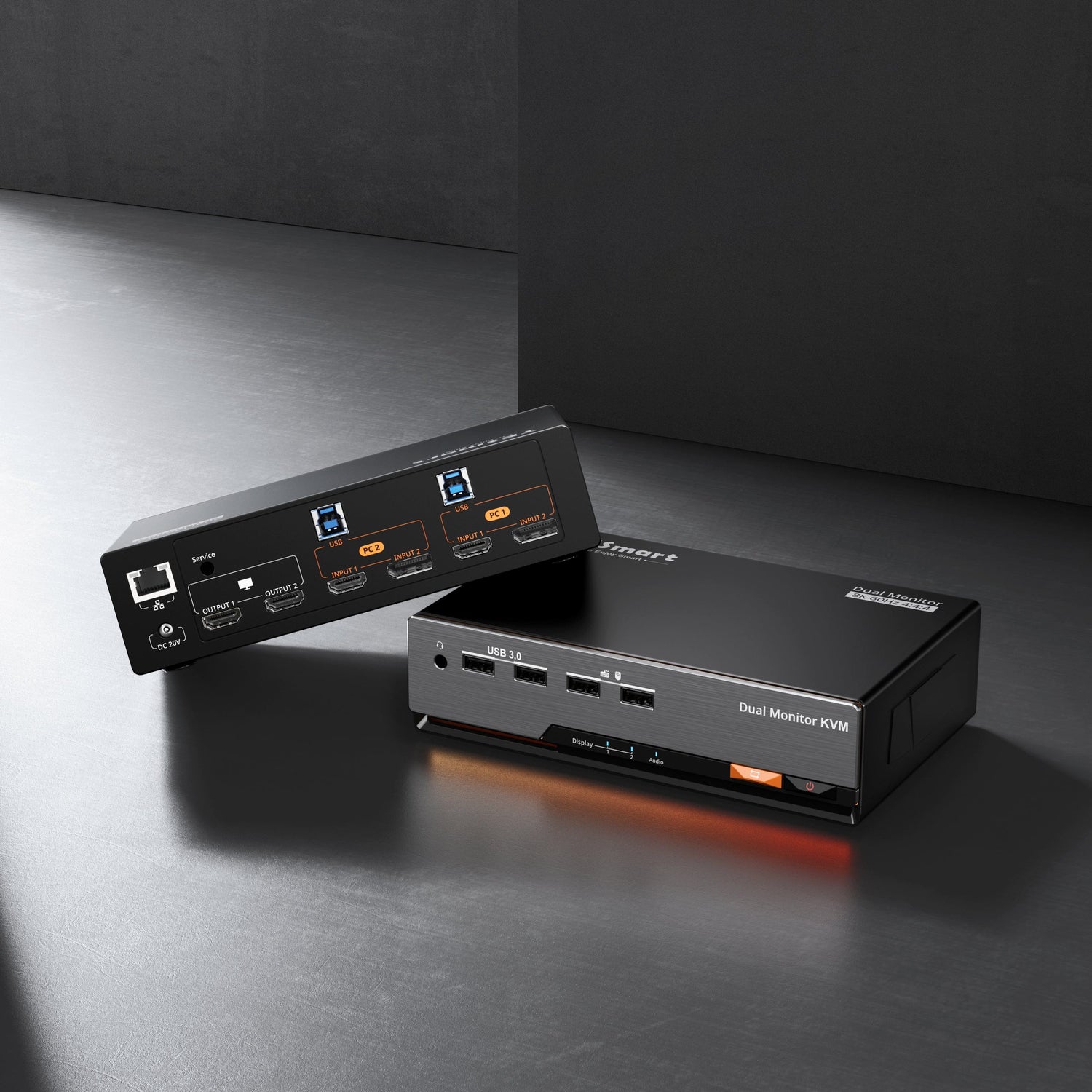
The Real Challenge Is Architecture — Not Bandwidth
As 8K displays and high-performance workstations become more common in professional environments, users often ask a seemingly simple question:
If a 4-port 8K KVM already exists, why is it so difficult to scale to 8 or even 16 ports?
At first glance, this appears to be a bandwidth problem. After all, 8K60 is already at the edge of HDMI 2.1.
However, in real KVM system design, bandwidth is not the primary bottleneck.
The true challenge lies in architecture.
This article explains why scaling from 4-port to 8-port and 16-port 8K KVM switches is fundamentally an architectural problem, and why only a few products can do it reliably.
1. One Important Clarification: KVMs Do NOT Process All Video Streams Simultaneously
A common misconception is that an 8-port or 16-port KVM must simultaneously process all incoming 8K video streams internally.
That is not how professional KVM switches work.
In a typical KVM design:
-
Only one input video signal is actively routed to the output at any given time
-
Non-selected inputs maintain link presence (EDID, HDCP state) but are not fully processed or forwarded
-
The system behaves as a high-speed signal router, not a parallel video processor
This distinction is critical.
It means that moving from 4 ports to 8 or 16 ports does not require multiplying raw video bandwidth inside the system.
2. Single-Port 8K Bandwidth Is Already Solved
An 8K60 HDMI 2.1 signal requires approximately:
-
~45–48 Gbps FRL bandwidth
-
Precise clock recovery, equalization, and jitter control
Modern HDMI 2.1 transceivers already support this.
From a pure bandwidth perspective, handling one 8K60 signal is no longer the challenge.
This is why 4-port 8K KVMs exist and work reliably today.
3. The Real Limitation: The 4×1 Nature of HDMI Switching Silicon
Most HDMI 2.1 switching solutions — including Analog Devices’ ADV7674 — are fundamentally 4-input / 1-output architectures.
What the ADV7674 Actually Is
-
4 HDMI 2.1 inputs
-
1 HDMI 2.1 output
-
Up to 48 Gbps FRL support
-
Integrated EDID management and HDCP 2.3
-
Fast input switching (InstaPort™)

In other words, ADV7674 is not a matrix chip.
It is a high-performance 4×1 switching building block.
This design choice is deliberate:
-
It minimizes latency
-
It avoids unnecessary internal bandwidth
-
It ensures signal integrity at extreme data rates
4. Why Scaling from 4 → 8 → 16 Ports Is an Architectural Leap
Once you understand the 4×1 nature of the switching silicon, the real difficulty becomes clear.
4-Port 8K KVM
-
One ADV7674
-
One HDMI output path
-
Straightforward control logic
8-Port 8K KVM
-
Multiple ADV7674 devices
-
Hierarchical or cascaded switching topology
-
Coordinated EDID and HDCP state management
-
Deterministic switching behavior across chips
16-Port 8K KVM
-
Further expansion of the same concept
-
Much tighter timing control
-
Higher firmware complexity
-
Greater validation effort
At this point, the challenge is no longer electrical bandwidth —
it is system-level orchestration.
5. The True Engineering Challenges in Large 8K KVMs
1) Deterministic, Glitch-Free Switching
Users expect:
-
No black screens
-
No re-training delays
-
No visible sync loss
Achieving this across multiple switching chips requires:
-
Precise control sequencing
-
Stable clock domains
-
Predictable HDCP behavior
2) EDID and HDCP Consistency Across All Inputs
Every connected host must:
-
See a stable EDID
-
Maintain HDCP authentication even when not selected
Any inconsistency causes:
-
Display re-detection
-
OS-level resolution resets
-
Application instability
3) USB and Peripheral Synchronization
A KVM is never just video.
An 8-port or 16-port KVM must also manage:
-
USB HID devices
-
USB 3.x peripherals
-
Audio paths
-
Hot-plug events
Synchronizing USB switching with video selection is often more complex than video routing itself.
4) Thermal and Reliability Constraints
Even without parallel video processing:
-
Multiple HDMI 2.1 transceivers generate heat
-
High-speed routing increases EMI sensitivity
-
Long-term stability becomes a primary design concern
This is why large 8K KVMs require careful component placement, power design, and firmware control, not just faster chips.
6. Why True 8-Port and 16-Port 8K KVMs Are Rare
Putting it all together:
-
Bandwidth is no longer the limiting factor
-
Silicon already supports single-port 8K60
-
The real barrier is scalable switching architecture
Designing a reliable 8-port or 16-port 8K KVM requires:
-
Modular switching blocks (such as 4×1 transceivers)
-
Sophisticated system-level control logic
-
Extensive validation across real-world devices
This is why such products are rare — and why many stop at 4 ports.
7. Practical Implementations from TESmart
TESmart addresses these architectural challenges with carefully engineered multi-port designs:
HKS801-M24 — 8-Port 8K60 HDMI 2.1 KVM
-
Built on modular high-speed switching architecture
-
Stable 8K60 HDMI 2.1 output
-
Intelligent EDID and HDCP management
-
Designed for professional multi-host workflows
👉 https://www.tesmart.com/products/hks801-m24
HKS1601-M24 — 16-Port 8K60 HDMI 2.1 KVM
-
Scales the same architecture to 16 hosts
-
Centralized control with deterministic switching behavior
-
Suitable for labs, studios, and enterprise environments
👉 https://www.tesmart.com/products/hks1601-m24
These products demonstrate that scaling 8K KVMs is not about pushing more bandwidth, but about building the right architecture.
Final Takeaway
The difficulty of building 8-port and 16-port 8K KVM switches is often misunderstood.
The real challenge is not raw bandwidth, but:
-
Modular switching topology
-
System-level coordination
-
Reliable, seamless user experience
Once this architectural problem is solved, true large-scale 8K KVM systems become possible — and practical.